Showing posts with label Esotericism. Show all posts

Monday, 22 June 2020

12th Annual Smashwords 2020 Summer/Winter Sale!


July 1, 2020 - July 31, 2020

This promotion has now closed. Thanks for your interest and participation. 

Four of my books sold through Smashwords will be  discounted during the month of July, so this is a chance to pick up a bargain! The catalog for the sale goes live at one minute past midnight on July 1 Pacific time, and expires 11:59pm on July 31. Clicking on the image of each book's cover below will take you through to the Smashwords page for it. Clicking on the title will taken you to a blog page giving further details.

During the sale period the price at Smashwords is the discounted price. Prices at Itunes, Barnes & Noble, Blio, Walmart, Inktera, etc. are not discounted. My new book, 'Echoes of Eternity' will be available for sale on June the 30th 2020 at the full list price, during and after the sale.

The bargains:

The Sacred History of Being (2015), is available during the sale period at 50% off the full Smashwords price.


Formerly argued by classical scholars to have been first discussed by the ancient Greeks in the middle of the first millennium B.C.E., the articulate concept of Being can now be traced as far back as the middle of the second millennium, and the state of Assyria. 
The Greeks themselves had several stories about the origins of philosophy, a discipline which essentially deals with abstractions, including that it originated elsewhere, but that is not the received narrative. The consequence of this, is that all historians of ideas, when constructing their accounts of the intellectual development of man before the arrival of Parmenides and Plato, have had to negotiate the Greek invention of philosophy, and the corollary, that articulate discussion of the abstract concept 'Being' didn’t happen before this.

This can now be shown to be a faulty understanding, resulting in many absurdities. The Old Testament has examples where God declares his identity with Being itself (‘I am that I am’, better translated into English as ‘I am that which is,’ and ‘I am the first, and I am the last; and beside me there is no God', for example), but these are not regarded by scholars as evidence of a sophisticated discourse around the idea of Being. Instead these statements indicate inchoate ‘notions’ about the nature of god, rather than anything more profound. The statement in Malachi, however, that 'I do not change', is an explicitly philosophical understanding of the nature of God.
Published by the Anshar Press.  


J.G. Frazer and the Platonic Theory of Being (2016) Is available during the sale period at a 25% discount from Smashwords.


When he was only twenty-four years old, James Frazer won a Cambridge fellowship with an essay on the development of Plato's theory of the Forms or Ideas (eidos). In this essay he argued that there was no overarching theory of Being in Plato's mind before he embarked on the writing of his dialogues, and that consequently differences in approach and discussion apparent in his work are the result of the development of his thought. He also argued that the very idea of Being is a barren notion, in that nothing can be predicated of Being. As a result Plato made a mistake, effectively conflating an epistemology with an ontology. 
Though the essay was written in 1879, it was not published until 1930, after much of his later work was done. Frazer became famous for his monumental study The Golden Bough, which explored a vast range of ancient and primitive myth and ritual. Here too he found intellectual processes founded in error. What was Frazer's intention in re-interpreting Plato against what Plato himself said, and his wholesale restructuring of ancient thought by reducing much of it to a pattern of error?
In sixteen sections, with prefaratory material and a conclusion. Over 23 thousand words, a preface, select bibliography, and extensive notes. Published Spring 2016 by the Anshar Press.  
A couple of related blog posts explore J.G. Frazer's discussion of Plato, and the implications for the writing of The Golden Bough. The two articles are synthesised together in a third article: Frazer and the Association of Ideas.


Understanding Ancient Thought (2017), is available during the sale period at 50% off the full Smashwords price.


Understanding Ancient Thought is the third in a series of books which examines how we assess evidence from antiquity, and frame models to make sense of that evidence.  
The book consists of eighteen essays, which cover a number of subject areas which are in thrall to what Foucault described as an ‘episteme’. In other words, the way the subject areas are understood within the academy is in terms of what our cultural models, language and assumptions will allow us to understand. The actual evidence may suggest an alternative view, but it is not possible to see it, or to think it. At least until the paradigmatic frame shifts to another ‘episteme’.  
The main thrust of the book is that two hundred years of modern scholarship concerning the past has, for the most part, assembled a fictive and tendentious version of the ancient world. 51 thousand words. Published by the Anshar Press, 
*** 

Man and the Divine: New light on Man's Ancient Engagement with God and the History of Thought, is also discounted by 50% during the Smashwords Summer/Winter sale. Published by the Anshar Press. ISBN 9780463665473. It is now available at Smashwords https://www.smashwords.com/books/view/872542. Published in August 2018.


Many of the essays deal with the question of esoteric knowledge in antiquity, often from slightly different angles. The book contains the following essays:
The Enlightenment of David Hume;  Richard Dawkins and Deism; Mathematics and Geometry;  Evading the Infinite;  The Esoteric Conception of Divinity in the Ancient World. Unwritten Doctrine, Ancient Silence; What is Sacred, and what is Profane?;  Intentionality, Conjecture, and What is Holy; Excellence and the Knowledge of Divine Things; Cultural Continuity in the Ancient World, and Bernal’s Black Athena. 


Wednesday, 30 October 2019

The Esoteric Conception of Divinity in the Ancient World (full text)


This article was first published in the Newsletter of the Bibliotheca Philosophica Hermetica in December 2015. In October 2019 the website went down, and hasn't come back up. So I'm posting the full text of the article here in the meantime. It covers both the subject of The Sacred History of Being, and also something of how the book came to be written. In 2018 the article was published as a chapter in Man and the Divine.

TY, October 30, 2019.


***


 “Enki’s beloved Eridug, E-engura whose inside is full of abundance! Abzu, life of the Land, beloved of Enki! Temple built on the edge, befitting the artful divine powers!”
From: ‘Enki’s journey to Nibru.’  (Black, Cunningham, Robson, Zόlyomi, The Literature of Ancient Sumer, 2004, p. 330)

The Sacred History of Being (2015) is about philosophy and its origin in the context of ancient cultic life. As such it argues that philosophy as a discipline is very old, as Plato himself said in the Protagoras, and that it was not invented by the Greeks.

In my twenties, I was struck by the strong interest the ancients had in the idea of limit – in art, architecture, philosophy, and ritual. This interest did not much seem to engage modern scholarly attention, with a couple of notable exceptions. Initially I had no idea at all what the significance of the idea of limit might be, and no idea where pursuing it would take me. Or that it would lead to a book it would take me four years to write, and which would reshape my understanding of human intellectual history in the process.

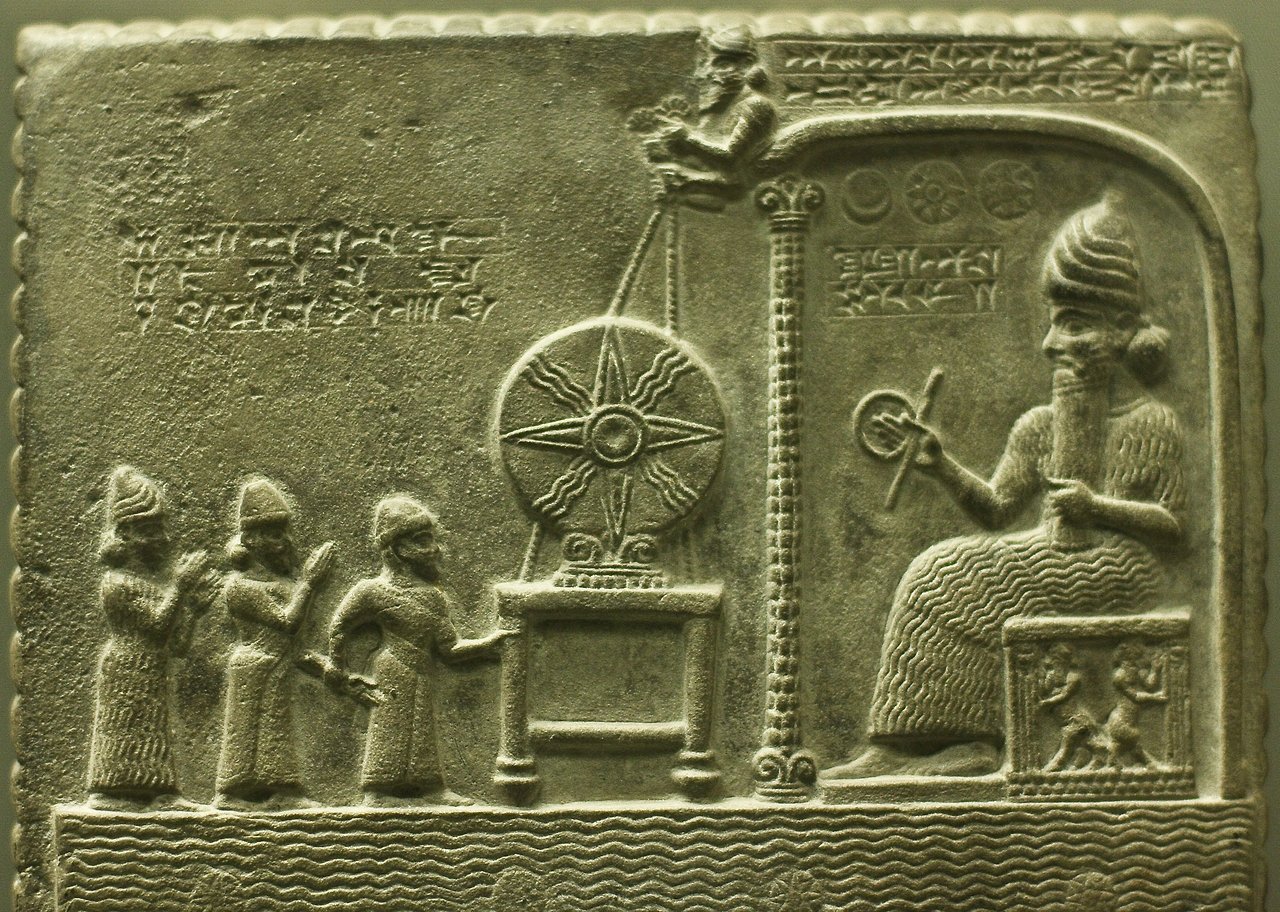
There is a standard form of image from the earliest years of civilization, which consists of two opposed figures, standing on either side of an object. The object can be a tree, an altar, a table heaped with produce, lotus blossoms, animal foreparts, loaves, and so on. The opposed figures can be human, animal, god or genie. This kind of image can be found throughout the archaeological record of the Ancient Near East, and in Egypt.

Questions arise from the ubiquity of this image, which appears in the context of those who had great power in the world, and also in funerary contexts, particularly in Egypt. It appears prominently in royal contexts in Assyria and in Babylonia. The image can be traced back as least as far as the settlement at Çatal höyük, now in modern Turkey, dating to some eight or nine thousand years before the present.

What does this image mean? It is nowhere explained, but clearly had some kind of explanation at some time, even if its transmission in later centuries was enabled simply by its status as a traditional iconographic element. Why is it so prominently displayed, so persistent throughout time, and apparently not discussed in the cultures in which it appears?

Some details of esoteric lore were written down in the Ancient Near East – the colophons of the relevant tablets make it clear that the contents were for the initiated only. The ritual procedures for the installation of divine statues in Assyria and Babylonia survive, together with some incantations which were part of the ritual. These tell us about the ritual, and the elements involved in the ritual – the thigh of a ram, best beer, mashatu-meal, and sacralised reeds, plus information about which stellar constellations and planets a statue was to be pointed at as part of the installation; and about the selection of craftsman’s tools which were disposed of as part of the ritual (enclosed in the ram’s thigh, and deposited into the river), in order to remove their responsibility for making divine images (not a thing for mortals to undertake).

But we find no discussion of the rationale of the installation ritual. Or discussion of the rationale of any other ritual which they documented. This suggests that there were levels in the esoteric life of Assyria and Babylonia: that the ritual details were important to record to ensure consistency in the performance of the ritual, but the meaning of the details, and the underlying rationale for the ceremony were transmitted orally, and never committed to writing.

The image with the opposed figures standing around a ritual object is clearly an image whose meaning and function was too important to record in a temple or palace document. In which case it might appear that we can never know what it signified, and why it was so important.

But, it is not so. Assyriologists have explored this image as it appears in the Mesopotamian context, and have made some headway in understanding the scope of its significance. They have established that, in terms of the iconography, the Sacred Tree may stand in for the King. In other words, the two ideas were understood to represent the same thing. The contemporary understanding of the nature of the role of king in Assyria was that he was the Regent of the god Ashur on Earth, and therefore the king represented an emulation and image of the Divine on Earth.

But why a tree? The tree can stand in for the king, because of two further ideas which are connected in the definition of what the king is.

The contemporary scholarly definition of the Divine in Assyria, framed it as the source of all excellences and perfections, and all knowledge.*1 Hence the importance of excellences and perfections of the life of the king, as we find recorded in the Annals of Ashurbanipal in the late 7th century B.C.E. (found in the ruins of his palace at Nineveh at the end of the nineteenth century). As Ashur’s representative on Earth he excels in military skills, in throwing the javelin, in horse riding, in the use of weapons; in divining the will of the gods through divination by oil, and other arcane skills; also in scribal excellence and mathematics – he is able to read the ‘obscure and difficult to master’ texts written in Sumerian ‘from before the flood’. And so on.

The excellence and perfection of the king’s skills were understood to place him in proximity to the god Ashur. He is thus at the limit of what a mortal may do and be; as Ashur is at the limit or zenith of Reality itself. Ashur is Reality itself. That the Tree may stand in for the king suggests that it was understood also as an esoteric and symbolic representation of the idea of limit, taken to the nth degree, and also of Reality itself.

Much of the discussion found in Plato concerns the nature of what he calls ‘The Good’. The Good is in a sense the Crown of Creation, and it is the target of human attention because of that status. He refers to the Good rather than ‘God’ because he is talking about the ultimate abstraction, which has commerce with other abstractions – as he says, ‘things pass into one another’. The Good is perfect, complete, whole, and the ultimate source of justice, good order, beauty, wisdom, and all the other abstract concepts which have some form of existence in the temporal world. He is careful to say (through the words of Socrates) that this ultimate Reality, the Form of Forms, has ‘no shape, size or colour’. In its nature it wholly transcends physical reality.

Plato’s Republic tells of the craft of passing from the contemplation of one Form to another, entirely intellectually, and without distraction, with the intention of eventually arriving at the contemplation of The Good. The man returning from this journey comes back with knowledge beyond the scope of any wisdom to be found on the Earth.

The Platonic discussion of the Forms is treated by modern scholars as a species of literary fiction. Meaning it has no detectable connections with cultural activity in Greece, or in any other part of the civilised world in the two millennia before the Common Era. But Plato is very clear that it is important to look to the ‘One Thing’, the ur-Reality which underpins the world of the here and now. So he is talking of a conception of God, which gives rise to all other things which may be understood by the mortal mind, though the ultimate abstract conception of Reality may lie forever beyond human understanding.

How old is this conception of the Divine? If the Divine is understood to have its reality at the limit of physical and perceptible reality, and to be the most abstract of abstractions, historians of philosophy would say this notion was first discussed in Classical Greece. If on the other hand, the iconography of the two opposed figures, facing a ritually significant object between them, represents the most abstract conception of limit, beyond any physical instance, then this conception of the Divine is thousands of years older than the middle years of the 1st millennium B.C.E.

The Assyriologist Simo Parpola has shown that there is a connection between the Kabbalah and the Assyrian Sacred Tree. Each of the Mesopotamian gods was associated with a divine number, and sometimes they were referenced in documents by their number alone. He was able to reconstruct the Assyrian version of the Kabbalistic tree, populating the sefirotic nodes (understood in the Middle Ages as divine powers and qualities), with the key Mesopotamian divinities, their properties and numbers.

The Kabbalah enshrines a philosophical notion of transcendent divinity in the concept of the ‘en sof’. It has been assumed by modern scholars that this is an imported idea, perhaps borrowed from Gnosticism in the early centuries of the Common Era. If in fact the idea of the ‘en sof’ was in the Assyrian version of the Sacred Tree, then we understand something new and profound about Hebrew ideas of divinity from the middle of the 1st millennium B.C.E. onwards.  The relationship between the Assyrian and Jewish Sacred Trees which Parpola has been able to show, by itself pushes a philosophical conception of the Divine back to at least the 14th century B.C.E., which is when the representation of the Assyrian Tree first appears.

This philosophical equation of the idea of limit with what is transcendent is an important factor in ancient religious ritual. In Mesopotamia the ritual installation of divine statues took place in locations with clear boundaries, including riverbanks and quays, and a key part of the ritual involved a temple threshold, as the surviving texts tell us. These boundaries were understood to have proximity to the primal reality, the Abzu, house of Ea/Enki, in the sweet waters at the bottom of the sea. Reeds used in the ceremony were spoken of has having their roots in the Abzu. The association of limit with ritual performance tells us something about the logic of the installation: the rites serve to make the images one with the company of gods in Heaven. The statue becomes itself Divine by its exposure to repeated representations of Divinity in the course of what was described in Mesopotamia as the ‘most sacred and secret of rituals’.

A great age for a philosophically conceived notion of Divinity, coequal with Reality itself, makes it possible to make much sense of many otherwise obscure texts and inscriptions which have been excavated over the past two centuries.  The determination of classicists over two centuries (since the European Enlightenment) to downgrade and deny the connections between Greek civilization and other civilizations around the Mediterranean and the Near East, both in classical times, and in the 2nd millennium B.C.E., has made it very difficult to make sense of both Greek philosophy, and the intellectual life of the other cultures of the ancient world. The Greeks accorded the Egyptians the status of philosophers, and Plato represents Solon having conversations with Egyptian priests in the Timaeus, who had knowledge ‘hoary with age’.  But archaeological excavation in Mesopotamia and elsewhere, and the recovery of thousands of texts, made possible the idea of writing something like The Sacred History of Being.

The structure of the book is relatively simple. There are three main parts. The first begins with reflections on philosophy, both ancient and modern. This goes some way to explain how I came to pursue this project. The second half of the first part discusses the ontological argument, which has its origins in the early modern period, which has come to be the principal way in which the reality of Divinity is discussed. We have made it very difficult to understand ancient theological ideas by promoting the ontological argument to its current status.

The second part explores Plato’s writing, and the strikingly different way in which Divinity was discussed. It also explores wider Greek thought, and earlier instances of the kind of understanding of Reality found in Plato.

The third part examines ideas common to Greece, Israel and Mesopotamia, plus the significance of the Assyrian Sacred Tree for the scholars of the Assyrian royal court, and the significance of the Jewish Kabbalah, which descends from parallel Mesopotamian ideas. Two of the chapters in part three work through the Mis Pî tablets from Nineveh and Babylon, which describe the ritual for the installation of images of the gods, and discuss the significance of the ritual.


1 The Babylonian scholar Berossus, former priest of Bel, who wrote about Babylonian culture and religion after moving to Athens,  tells us of the encounter of the first legendary sages with an emissary of the Divine. The emissary granted them knowledge of the arts and crafts, of husbandry, and the apportioning of land.

Saturday, 9 February 2019

The Roots of Philosophy: Six Books by Thomas Yaeger


The Sacred History of Being (2015)


The discipline of philosophy was not invented by the Greeks, but was in existence elsewhere, and as far back as the middle of the second millennium BCE. It has its origin in ancient divine cult. The detail of its presence can be traced in the civilizations around the ancient Near East, and particularly in Assyria and Babylonia. The Sacred History of Being collects the key evidence together, and examines the idea of the divine as a philosophical concept in Greece, Israel, and ancient Mesopotamia. Published as an eBook by the Anshar Press, November 2, 2015. 113k words. Available from Barnes & Noble, Itunes, Kobo, Blio, Inktera, Smashwords, etc. More information available at: https://shrineinthesea.blogspot.co.uk/p/the-sacred-history-of-being-as-its.html


J.G. Frazer and the Platonic Theory of Being (2016)


When he was only twenty-four years old, James Frazer won a Cambridge fellowship with an essay on the development of Plato's theory of the Forms or Ideas (eidos). In this essay he argued that there was no overarching theory of Being in Plato's mind before he embarked on the writing of his dialogues, and that consequently differences in approach and discussion apparent in his work are the result of the development of his thought. He also argued that the very idea of Being is a barren notion, in that nothing can be predicated of Being. As a result Plato made a mistake, effectively conflating an epistemology with an ontology. Though the essay was written in 1879, it was not published until 1930, after much of his later work was done. Frazer became famous for his monumental study The Golden Bough, which explored a vast range of ancient and primitive myth and ritual. Here too he found intellectual processes founded in error. What was Frazer's intention in re-interpreting Plato against what Plato himself said, and his wholesale restructuring of ancient thought by reducing much of it to a pattern of error? Over 23 thousand words, a preface, select bibliography, and extensive notes. Published by the Anshar Press, April 4, 2016. http://shrineinthesea.blogspot.co.uk/p/j.html


Understanding Ancient Thought (2017)


'Understanding Ancient Thought' is the third in a series of books which examines how we assess evidence from antiquity, and frame models to make sense of that evidence. The book consists of eighteen essays, which cover a number of subject areas which are in thrall to what Foucault described as an ‘episteme’. In other words, the way the subject areas are understood within the academy is in terms of what our cultural models, language and assumptions will allow us to understand. The actual evidence may suggest an alternative view, but it is not possible to see it, or to think it. At least until the paradigmatic frame shifts to another ‘episteme’.The main thrust of the book is that two hundred years of modern scholarship concerning the past has, for the most part, assembled a fictive and tendentious version of the ancient world. 51 thousand words. Published by the Anshar Press, August 20, 2017. Available via Smashwords, Itunes, Barnes and Noble, Blio, Kobo, etc. http://shrineinthesea.blogspot.com/p/first-look-at-my-new-book-which-should.html


Man and the Divine (2018)


A collection of essays on philosophy, ancient cultic thought, and the problems of addressing and interpreting ancient evidence. The book also examines the nature of esoteric thought in antiquity, and the transcendentalist nature of ancient religion.  21 chapters. 

The Enlightenment of David Hume. Though Hume's empirical approach was not wholly successful, some of his intuitions expanded our collective understanding of how we perceive reality – for example, his insight that we have no actual knowledge of the process of causation at all, and only a customary expectation of causal process, was a powerful one. We can describe causal processes, we can differentiate the nature of different causal processes, and we can formulate rules in connection with them, but we cannot know how causality itself operates, or even be sure that a perceived causal relation, often observed before, will obey the implicit rule the next time it is under scrutiny by us. However, it is no longer clear that Hume was exploring his mental processes and understanding entirely within the framework of western secular thought. This chapter is based on intriguing research by Alison Gopnik.

The Death of Socrates. It is a puzzle that, in the midst of a thoroughly polytheistic culture in Athens, with its plethora of gods, its many cults and priesthoods in the service of those gods, that both Socrates and Plato could speak of ‘god’ in the singular. Our difficulty here is the result of a modern understanding of the significance of polytheism, which sees the phenomenon as the inevitable precursor to monotheistic belief, which excludes other gods from consideration, or credibility. For modern scholars, polytheistic belief in ancient Greece was something which developed, higgeldy-piggeldy, out of a plethora of local and tribal deities, much embellished with myths about their lives and actions, which served important social functions, but which had no universal meaning, and were not rooted in a model of reality which embraced consideration of what the nature of reality itself might be.

The Irrationality of Atheism, Atheists do not deny the existence of the world, its laws and properties: they just argue that the concept of God is not required to accept the world, and to have an understanding of it. But this leaves them at a loss to explain how the world came to be, and why it should have come into existence.

Richard Dawkins and Deism. Modern atheism is actually dependent for its nature on the ontological argument, and the terms in which it is framed. Meaning that eight hundred years of argument about the nature and existence of God underpins the point of view of those who regard themselves as atheists. Dawkins makes a distinction in ‘The God Delusion’ between theism and deism. Theism is a pattern of belief which enshrines the idea that the Divine is responsive to man, and his rituals of worship and prayer. It is a pattern of belief dependent on the idea that God can act in the world. By contrast, deism contemplates the idea that a creator God has existence, and necessarily created the world, but that he is not active in the physical world beyond that. This essay argues that Dawkins is in fact a modern deist rather than an atheist.

Contra Plantinga. Alvin Plantinga was kind enough to accept a copy of The Sacred History of Being. I sent two supplementary emails which outlined the implications of its criticism of the traditional ontological argument, whose function is to support a rational basis for belief, which are reproduced here.

Distinguishing Belief and Faith. Modern scholarship has a track record of making easy assumptions about the continuity of religious ideas and patterns of practice, and the accompanying social compacts. At the time the Assyrian palaces, temples and cities were being dug from the sand and soil in northern Mesopotamia, it was assumed that the relationship between the royal and temple establishments could be understood in terms of a modern division between church and state. This notion turned out to hold very little water on close analysis. It is also the case that belief is not a conspicuous feature of ancient religions.

Logic, Sophistry, and the Esoteric in Ancient Education. Both Plato and Aristotle's writings contain arguments which either don't make clear logical sense within themselves, or in the context of the rest of the work. Sometimes the clues to the meaning of arguments are present elsewhere in the canons of both Plato and Aristotle, and some of them clearly involve an esoteric level of understanding. The whole body of their outputs need to be taken on board in order to grasp the meaning of individual works. This is usually not done with the works of Aristotle: his Historia Animalium is read by biologists and specialists in animal taxonomies, but usually they read little else of his work.

Beyond Mathematics and Geometry. The process of separating ourselves from an interpretation of the world in terms of simple apprehension is driven initially by the practical necessities of our existence. But this process does not need to stop there. Intelligence consists in being able to adjust the categories of our understanding so that we do not mistake one thing for another. It is a mental development which might have no end. This is essentially how Kant understood human intellectual development, which he framed (in his Prolegomena) in terms of a general theory of a priori concepts, not based on empirical sense data, or even a mathematical or geometric understanding of anything in the world.

Evading the Infinite: A Review of A.W. Moore’s ‘History of the Infinite’. This chapter is a critical response to Adrian W. Moore's radio series 'The History of the Infinite', broadcast in the autumn of 2016, and his book 'The Infinite', published in the early 90s. His treatment of the subject hardly references Plato at all. Adding Plato to the discussion changes the way in which the argument should be framed. The actual infinite is the principal source of ancient ideas concerning the divine, not Aristotle's potential infinite, so Moore's argument concerning our knowledge of God is forced to take refuge in the quasi-mystical Calvinistic idea of a 'sensus divinitatis'. His argument also makes it impossible to understand Kant's treatment of religion.

The Esoteric Conception of Divinity in the Ancient World. In my twenties, I was struck by the strong interest the ancients had in the idea of limit – in art, architecture, philosophy, and ritual. This interest did not much seem to engage modern scholarly attention, with a couple of notable exceptions. Initially I had no idea at all what the significance of the idea of limit might be, and no idea where pursuing it would take me. Or that it would lead to a book it would take me four years to write, and which would reframe my understanding of human intellectual history in the process.

Unwritten Doctrine, Ancient Silence. It is often assumed by students of antiquity that there is no special importance to be attached to remarks that certain items of information are to be kept secret and not imparted to the unworthy, and to the ordinary mortal. This assumption is based on the presumption that there was, and is not, anything about which it is impossible to speak of, before those not used to dealing with information about religion and the divine. This is a curiosity of modern times, in that the ignorance of theology among the moderns makes it impossible for them to credit the importance of theology in antiquity - both to those who understood its subtleties and and those who didn’t.

Ancient Conjectures, and Fictive Intellectual History. Plato argues that we should always look to the ‘one true thing’. J.G. Frazer also argued that questions concerning Being (‘the one true thing’) were entirely barren, since nothing could be predicated of Being. This of course is a spectacular instance of intellectual blindness, by which the richness of the intellectual matrix of ancient Greek thought was spirited into nothingness. In antiquity, nods were made toward the notion that the discipline of philosophy might not have been first developed in Greece, including (tellingly) at the beginning of Diogenes Laertius' Lives of the Philosophers. Plato after all argued against the idea that philosophy was invented by the Greeks in the Protagoras, saying that it was of a great age – perhaps contemporary with the arrival of peoples from Egypt, who settled in the Peloponnese, and also in Crete.

What is Sacred, and what is Profane? Each of the divine names of Marduk, the head of the Mesopotamian pantheon, has a description, and each of the lesser gods can be understood as abstractions of aspects of the rational creation. They represent excellences in the world. Marduk represents the sum total of these. This is the clue to understanding much of the ancient understanding of what the divine is. Each described excellence resembles reality itself in terms of its properties. The excellence may serve social functions, as does a skill or specialism, but it should be performed for its own sake. The performance of these excellences recalls the perfection and completeness of the plenum, and reinforces the presence of the divine in the world. 

Intentionality, Conjecture, and What is Holy. Intentionality explains why the ancients created a multiplicity of gods. If the divine itself cannot by definition be completely defined and understood, at least certain properties and attributes can be understood. These can therefore be defined and named as ways of accessing the divine. This does not at all conflict with the idea that the reality of the divine is in question. Instead this view argues that there is in fact a subjective component in the reality of the divine, at least insofar as it is possible for us to have commerce with it.

Excellence and the Knowledge of Divine Things. Plutarch opens his life of Alexander with a cheerful complaint about the sheer extent of the materials available to him to write on Alexander. So the details which are in his essay are there because he regarded them as important in showing Alexander’s character, his disposition, and the content of his mind. On the basis of his sources he says that it is thought that Alexander was taught by Aristotle not only his doctrines of Morals and Politics, but also those more abstruse mysteries which are only communicated orally and are kept concealed from the vulgar: for after he had invaded Asia, hearing that Aristotle had published some treatises on these subjects, he wrote him a letter in which he defended the practice of keeping these speculations secret.

Egypt in the Shadows. Since the European enlightenment, the influence of Egypt on the development of abstract and philosophical thought has been deprecated. Yet, as Martin Bernal showed in the third volume of Black Athena, many Greek words have plausible etymologies from Egyptian. It is also the case that several of the concepts used by Aristotle in his philosophical writing were known to Egyptians nine hundred years before his time, such as the idea of completion (it is connected with the idea of birth in Akhenaten’s Hymn to the Aten, which dates to the fourteenth century BCE). There is also abundant evidence for the existence of philosophical thought among the Hebrews in the books of the Old Testament. Yahweh is described as ‘the first and last, and beside me there is no God’. His name (minus the vowels) is a variant of the verb ‘to be’, which suggests that his isolation is due to the fact that he was understood to be Being itself.

Polytheism, Monotheism, and the Cult of the Aten. The Aten is first mentioned (to our knowledge) in the Story of Sinuhe, which dates at least as far back as the twelfth dynasty, where the dead king is described as uniting with with the sun-disk in the heavens. Akhenaten’s iconography never shows the god in anthropomorphic form – instead the Aten is always shown as the sun disk with rays of light extending from it, with hands at the end of each ray. The Sun god was considered to be neither male nor female, but both simultaneously, an idea which was reflected in the depiction of Akhenaten in sculpture and reliefs. His full title however was ‘The Ra-Horus who rejoices in the horizon, in his/her Name of the Light which is seen in the sun disk’. We find this full rendering of the Aten’s name on the stelae placed around Akhetaten, which was Akhenaten’s newly founded capital. Sometimes the full name was shortened to Ra-Horus-Aten, or just ‘Aten’. Since two of the names of Akhenaten’s god refer to the sun (Ra being an older name for the sun god), it seems that some kind of intellectual synthesis of older ideas had taken place.

Cultural Continuity in the Ancient World, and Bernal’s Black Athena. Martin Bernal’s intention was to take ancient Greece out of its exalted orbit above all other civilizations, and root it in what he assumed to have been a cultural continuum around the Mediterranean sea from at least the mid-2nd millennium B.C.E up until the classical period of Greece in the 5th and 4th centuries B.C.E. Bernal pointed to the evidence within the texts of the 1st millennium which suggested cultural continuities with ancient Egypt – all dismissed by the classicists in favour of evidence in texts which could be interpreted as suggesting the opposite. Bernal’s attempts to establish cultural continuity with the civilizations around the Mediterranean were hampered by the fact that myths are not simply encodings of historical and political change, and that the exchange of words between linguistic groups is, by itself, weak evidence for cultural continuity. He was correct to guess at the existence of the cultural continuity, I think, but ill-equipped to establish such a thing. To do this requires moving things around – particularly re-anchoring the relationship of Greek philosophy to patterns of religious belief and cult practice; and the establishing of the relationship between Greek patterns of religious belief and cult practice to parallel ideas and behaviour in the Near East and in Egypt.

The Tangled Thread: Universals in History. The liturgies and the description of ancient rituals have been published and translated, and their signifcance and meaning have been discussed by scholars. But they make difficult reading for the reason that they involve a different set of preconceptions from those understood by Mesopotamian scholars. It is hard to break through to an understanding of what was understood to be going on. The Mesopotamians employed ideas which they considered to be universally valid, such as all wisdom being present in the Abzu, and that the acquisition of knowledge depended on some kind of ritual engagement with Ea and the Abzu. And that the good order of the world depended on man's relation to the world of the divine. Since the European Enlightenment however, we have adopted another set of universal notions, which do not depend at all on the reality of the divine and the gods. In fact it pushes such notions into the shadowlands of unreason. So there is little inclination among scholars who specialise in Mesopotamia to spend time trying to makes sense of things which they regard as intrinsically unreasonable.

The Age of the Lord Buddha. Scholars acquiesce in the convention that an articulate and technical understanding of the idea of Being was first broached by the Greeks in the middle of the 1st Millennium BCE. It follows therefore that all references to the divine in the ancient near east before that date are not articulate and technical references, but notional and inchoate. The consequence must be that we can learn nothing useful about ancient intellectual processes and concerns from these notions, since they are beliefs entirely unsupported by rational argument. This would come as a surprise to many ancient cultures, if they were still around. The date of the Buddha's floruit for western scholars is much closer to our own time than it is for scholars in the east. We place him around the 5th century BCE, since there is clearly an interest in universals in the texts. The Puranas provide a chronology of the Magadha rulers from the supposed time of the Mahabharata war, and Buddha is supposed to have become enlightened during the reign of Bimbisara, the 5th Shishunaga ruler, who, according to this chronology, ruled between 1852-1814 BCE. His birth date may have been 1887 BCE. Chinese scholarship has long maintained that Buddhism came to China from India around 1200-1100BCE.

Stone Circles, Phenomenology, and the Neolithic Mind. The evidence from the megaliths makes the importance of the sky very clear: in Britain and around the megalithic world, the sky was seen as a representation of divinity, of Being. As an image of the divine, it was an image of totality itself. The megalithic observatory, or temple, according to this hypothesis, was a device to embody aspects of divinity, of Being, actually in its structure, in the same way in which the gods in Mesopotamia might be invited to occupy their representations on earth.

Available from my distributor Smashwords, and various retailers, including Itunes, Barnes and Noble, Blio, Inktera, etc, and a number of library distributors.

56,320 words. Published by The Anshar Press, Aug. 12, 2018. https://shrineinthesea.blogspot.com/p/man-and-divine-2018.html


Echoes of Eternity (2020)


My new book, will be available in May 2020 (rescheduled). The final word count will be around 56 thousand words. Two of the chapters - 'The Greek Ontological Model in the 1st Millennium B.C.E', and 'Patterns of thought in Late Neolithic and Early Bronze Age Britain', are quite large pieces of work (6k and 10k words respectively).

Much of the cultural production of the ancient world, east and west, was based on the idea of reflecting aspects of the divine in human life and thought. Many social structures and institutions were based on this approach. The model for these things was was astronomy and the heavens, and the heavens were conceived of as a moving image of eternity, and eternity was understood to be coterminous with the Divine. Since it moved, it contained life and thought, and repaid the attention of man. We still live, work and think inside what is a scarcely changed neolithic temple, which is the sky.

The chapter list:

Introduction: The Interpretation of Ancient History

Part One

Camera Obscura: Marx, Aristotle & Ptolemy
Synoikismos and the Origins of the Polis
Proskynesis, and the Deification of Alexander


Part Two

The Greek Ontological Model in the 1st Millennium B.C.E.
Greece and the cultural Impact of the Assyrian Empire
The Threshold in Ancient Assyria
Symmetry and Asymmetry in the Iconography of the Ancient Near East

Part Three

Being and Eternity in the Neolithic
Patterns of thought in Late Neolithic and Early Bronze Age Britain
The Mathematical Origins of the Megalithic Yard
What We Have Lost, and How the Ancient Concept of the Cosmos Died
Marx and Historicism

Visit my profile page at Smashwords and scroll down for the books.


Updated May 28,  September 6, October 1, December 11, 2019, and May 2, 2020.


[The Death of Pan replaces 'The Origins of Transcendentalism in Ancient Religion', (forthcoming).]

This is a short book about a very large subject – the transcendentalism which is present in ancient religions, located to the west of India. 

Normally it is assumed that there is very little in the way of transcendentalist thought associated with these ancient religions, and that the evidence we are looking at is mainly built out of concrete imagery, fanciful myth, poetry, irrational associations, all of which are in the service of religion and the state. In other words, religion serves a series of social and ideological functions, and it is to those functions that we should look for the explanation of the cultural remains, rather than the minds of the ancients themselves.

Is this actually so? Or are we the victims of an enlightenment agenda which sought to remake the history of religion and religious thought in terms of a profound irrationality?

That is one of the arguments of this book – that we have been sold short by enlightenment presumptions and certainties, and that what we think we know and understand about ancient religion is so far from its real basis that, for the most part, it is nearly impossible for modern scholars to make intelligible sense of it.

This book is short, not because the questions it addresses are simple, and have easy answers. It is short because I have written five other books before this one, and, to a significant extent, it references argument and discussion which can be found in those books. It was not possible to write a short and credible introduction to an understanding of the transcendentalism which can be found in ancient religions, without first covering an enormous amount of ground.

Scholars must decide for themselves if the argument of this book is soundly based.  The problem for scholars  is that they live and work within what Michel Foucault called an ‘episteme’. This is a model of reality dependent on many presumptions. Not only does the episteme shape discussion, it controls what can actually be discussed, or even be seen by those within it.

Preface

An Appetite for Knowledge
The Death of Pan
On Ancient Religion
Parallels and Discontinuity between Contemporary and Ancient Religions
The definition of Transcendentalism in Religion
The Origin of the Transcendentalist Perspective 
The Nature of Reality 
Contradiction and Paradox 
Transcendence and Immanence 
Detecting the Presence of Transcendentalist Thought 
The Future of our Understanding of the Past

Appendices:

The Obsolescence of Oracles (Plutarch).
Who Will Appear Before the City?
Wearable Fictions, Phenomenology, and the Grammar of Human Thought 
Notes

*Update, May 22, 2020:

Sometimes a book changes during the process of research and writing. The writer of anything is in a dialogue with both his materials and his thoughts. That is what has happened with this book. It will contain the discussions outlined above, but it will be significantly different, since it will also discuss a famous essay from late antiquity (The Obsolescence of Oracles), which illuminates the underlying argument of the book, and shows that there was a consciousness present in the second century C.E., that ways of thinking about the Divine were changing, and that the older modes of thought were about to be largely lost.

The author of this essay understood that the patterns of thought of the ancient world would no longer be accessible to those who came afterwards. Rational discussion of these patterns of thought would disappear, and would be replaced by an entirely ersatz mode of discussion, and shape almost everything which could be thought or said afterwards. With almost none of it making any kind of sense.

The title of the book will be different, reflecting the changes to the book's contents. There will be a new page for this shortly. TY

Update: Jun 6, 2020

The book title is now 'The Death of Pan'. We commonly imagine that what we regard as modern rational thought emerged from an intellectual world that was not rational at all. But ancient civilizations regarded themselves as rational. What actually happened is that one form of rational thought experienced a long and slow collapse, and began to be replaced by another (also a slow process). We have imposed this notion of a progressive development of rational ways of thinking onto our intellectual history, despite the fact that the evidence we have available to us tells another story altogether.

Updated June 6, 2020

Wednesday, 4 October 2017

Letter to a Student


[A response to an email from a student in New York which commented on matters discussed in an article I wrote for the Ritman Library Newsletter in December 2015, shortly after my first book was published. He has been studying the Italian renaissance, and is interested in the history of esoteric ideas, ancient and modern, and the connections between them. He is also interested in why college courses are set up in the way they are, so that they don't always address the kind of questions which a student might want to explore.] 


***


Many thanks for your mail, and for your comments on the article titled “The Esoteric Conception of Divinity in the Ancient World.” I was put on to the significance (and antiquity) of the Assyrian Sacred Tree by the Assyriologist Simo Parpola, who published an extensive paper on the subject in 1993 ('The Assyrian Tree of Life: Tracing the Origins of Jewish Monotheism and Greek Philosophy'). There is much discussion of the Sacred Tree in The Sacred History of Being.

By ‘esoteric texts … that cite Assyrian and Sumerian sources’, I assume you mean modern books on esotericism that mention these sources. You will be aware that you have to use these with circumspection, since some of them (not all of them) use their sources cavalierly, with no real grasp of the materials they are using, or the languages in which they are written.

But there are undoubtedly strong connections between esoteric writings from Mesopotamia, and the later esoteric traditions around the Mediterranean and in Europe. When I was in my early twenties I was reading about esotericism in the Italian and English renaissances. Afterwards I began to read texts from late antiquity, largely because these were referenced by the later writers. The continuity of thought was quite striking.

I worked my way back further. I found a text from the middle of the 14th century B.C.E. in a collection of ancient Egyptian literature which employed what appeared to be philosophical concepts, which, according to convention, were first aired in Classical Greece. That’s a difference of 900+ years
From that point on I was hooked.

You will know that Plato recounts in the Timaeus that his ancestor Solon visited Egypt. As did the historian Herodotus. In college both these claims were downplayed as unlikely, as if it was difficult to undertake travel to Egypt at the time. But we were also learning of the extensive commercial connections known between Greece and the eastern Mediterranean in the same period, involving the establishment of permanent trading posts with regular and substantial traffic to and fro. How hard would it have been to get a passage from Greece to Egypt on a cargo ship?

The downplaying of connections between Egypt and Greece, has been going on for a long time – at least since the beginning of the European Enlightenment. Most college professors are following a well-travelled track, which they assume to be a rational response to the evidence. As a consequence, they aren’t much interested in counter arguments, and evidence which suggests they are on a false track. They structure their courses accordingly. They aren’t being dishonest. They are just living and working in a discipline which employs a model of the past which (they think) has more plausibility than is the case.

I’ve discussed the origin of this problem at some length in my book. In the end, this question became almost as interesting to me as the study and interpretation of ancient texts. It turns out that human beings are (generally speaking) less curious creatures than we like to think, and that there are some things out there which they would rather avoid.

Others have radar for arguments which are on a different track, as you clearly have. So yes, I would be happy to correspond with you about various matters of interest. Subject to available time of course.

I concur with your decision to read my book once you graduate. I wrote in the preface that, though it is a scholarly work, it is not a text book, and that it would be less career-threatening to read it after credit courses are safely over.

Best regards,


Thomas Yaeger

Tuesday, 23 May 2017

Unwritten Doctrine, Ancient Silence


[This is an extract from  'Unwritten Doctrine, Ancient Silence',  one of twenty-one essays in the book Man and the Divine, published in August 2018. The book is available in ePub format from leading retailers of eBooks, such as Barnes & Noble, Blio, Kobo, Itunes, Inktera, Smashwords, etc. Information about Man and the Divine can be found here]

Plato was quite explicit in the Timaeus that it was not possible to tell all men about ‘the Father of the Gods’. It follows from this that if, as in Plato’s case, doctrine comes from an understanding of the divine, then there must be an unwritten doctrine beneath the written texts which contains at least what makes sense to Plato himself, and perhaps an inner circle of peers or advanced students.*[1]

It is often assumed by students of antiquity that there is no special importance to be attached to remarks that certain items of information are to be kept secret and not imparted to the unworthy, and to the ordinary mortal. This assumption is based on the presumption that there was, and is not, anything about which it is impossible to speak of, before those not used to dealing with information about religion and the divine. This is a curiosity of modern times, in that the ignorance of theology among the moderns makes it impossible for them to credit the importance of theology in antiquity -  both to those who understood its subtleties and and those who didn’t.

In other words, it is assumed that what is proclaimed secret is not something which, within the culture in question, must necessarily remain secret (otherwise dire consequences might follow), but is something local to a particular cult or religion, and is an artificially created object of mystification, created for the benefit of the cult, to increase the aura of that cult, and to promote its ideology.

There is another possibility which should be considered, if only to clear up the scope of the phenomena we are looking at: if the priests in antiquity proclaimed that the secrets pertaining to the gods should necessarily remain secret, what might be the nature of such secrets?

Naturally it is not being suggested that all religious structures and institutions in antiquity would subscribe to what we might call ‘rational circumspection’ and a necessary element of secrecy. But it is important to explore the possibility that sometimes, and perhaps for the most part, as it might turn out if we look closely enough, these structures and institutions had what they understood as very good reasons for this way of operating. It is too easy to write off this aspect of ancient life on the grounds that of course they would say this kind of thing about themselves and their institution even if there were no rationality at all in the practice. Certainly ancient religious belief was as subject to political manipulation and machination as in the modern world, but it does not follow that there was nothing more substantial to the religions of the ancient world than a purely ideological tool for a power elite who believed in absolutely nothing (though it might be perfectly fair to suggest that modern power elites believe in nothing but power itself). 

If we presume the  ancients did not believe in the rational sense of their religion and their cultic practices, at least at some level, then a whole raft of other questions would need to be answered, We would have no way, for example, of fathoming why the story of Agamemnon’s sacrifice of his daughter Iphigenia in order to gain a fair wind for Troy, was credible to an ancient audience, and made some kind of sense.

Clearly the truth is likely to lie somewhere in between the two extremes of belief and disbelief in the tenets and imperatives of ancient religion. But if we do not explore belief and its reasons in antiquity, we can never know detail of the level of rationality in ancient religion. This is not a problem, if, as is implicit in many modern studies of ancient religion, we assume that religion is at root an irrational response to the complexity of both nature and human society. The argument that there may be a rational component in ancient religions therefore can be understood as an attempt to elucidate the extent to which this might be true, and to challenge the conventional view that there is nothing of  the sort to be found there.

Plutarch gives some interesting information about Alexander’s intellectual background in his account of Alexanders career. He wrote that: ‘It would appear that Alexander received from [Aristotle] not only his doctrines of Morals, and of Politics, but also something of those more abstruse and profound theories which these philosophers, by the very names they gave them, professed to reserve for oral communication to the initiated, and did not allow many to become acquainted with. For when he was in Asia, and heard Aristotle had published some treatises of that kind, he wrote to him, using very plain language to him in behalf of philosophy, the following letter’:
Alexander to Aristotle greeting. You have not done well to publish your books of oral doctrine; for what is there now that we excel in others in, if those things which we have been particularly instructed in be laid open to all? For my part, I assure you, I had rather excel others in the knowledge of what is excellent, than in the extent of my power and dominion. Farewell.*[2]
This is generally taken to be a reference to Aristotle’s Metaphysics. However at the time Plutarch was writing, perhaps the late 1st century C.E., or the early 2nd century,  it is likely that Aristotle’s Metaphysics had not surfaced as a published work. *[3] It is unlikely on this account to be a genuine letter. Nevertheless, the passage reflects the ancient perception of an agrapha, an unwritten and orally communicated doctrine underlying the public work of both Aristotle’s Lyceum, and Plato’s Academy.

What could possibly be of such importance to withhold, and from whom? The story of the prisoners in the Cave in the Republic of Plato gives the general outline of the problem. The simile involves a group of men whose only means of apprehending reality in a darkened cave is the shadows of things cast on the wall by the flames of a fire. For these men, there is no other reality. Were they to become aware of the fact that they were not seeing real objects, but only shadowy two-dimensional representations of real objects, this would cause them to have to restructure their picture of reality. The problem would be so much worse if they were released from the cave into the sunlight. Plato invokes the strength of the sun’s light as part of the simile, and suggests that the prisoners would have to look at the image of the sun via darkened pools of water, before attempting to gaze on the light of the sun directly (as if one would ever want to advise this).

In the story of the Cave, the sun is the image of the Good, the Form of Forms, and the ultimate source of all representation and experienced reality. Plato, by means of the story of the Cave and its inhabitants, is illustrating his view that reality is an extremely complex phenomenon, and that it cannot be understood easily without preparation. Were the complexity of reality, or rather its understanding, to be introduced baldly to men unprepared for what they were about to hear and see, they would be unable to comprehend it for what it was, and might attack those who were leading them out of the Cave into the sunlight.*[4]

Anyone who has explained technical or abstract information - which is to some extent counterintuitive in nature - to someone who has a narrow and concrete understanding of the world and its parts, will understand something of the problem which Plato is addressing here. Explaining to an untutored musician that (for example) the modern piano keyboard has actually been detuned to make the full range of polyphonic composition possible, is likely to produce an adverse reaction, despite the fact that it is quite true. The reaction is likely to  be complete disbelief, so used have we become to the tuning of the equal-temperament keyboard.

This of course is a relatively trivial example. The Good in the writings of Plato is a transcendent concept, beyond any earthly exemplar, and extremely difficult to communicate even to an educated and informed audience. Plato is clearly signalling that, beyond the simple difficultly of explaining the nature of reality to those who, for whatever reason, have been brought up with a weak and threadbare account of it, there is a necessary and unavoidable difficulty in understanding the concept of the Good and that the difficulty inheres in the nature of the Good.

The Good, as defined in the work of Plato, is taken to be Plato’s own conception. Clearly it has something to do with the nature of the divine, though Plato is often read as if he is speaking purely philosophically, whatever that might mean in the context of ancient Greece. The Good is, as Plato discussed the concept, not something which we expect to find in earlier contexts. The remark of Christ in the Gospels that none should be called ‘Good,’ but God is of course made several centuries later, and in a milieu where Greek philosophy was familiar, *[5] but when, in the book of Genesis, God looked upon his handiwork at the end of the first week of creation, ‘he saw that it was good.’*[6] Genesis represents a redaction of earlier texts, probably compiled in the fifth century B.C.E., in the time of the Persian domination of the near East. Scholars blink at this reference, and do not see what is there in the text.*[7] No rational philosophical concept is involved.

The only public lecture Plato ever gave was on ‘the Good’. It was not a great popular success, and treated the subject in such a mathematical way that the audience had great difficulty in understanding what he was talking about.*[8] We might be on the right track by suspecting that Plato had no intention of being understood by the bulk of his audience, and that the matter of his talk was not intended for the ears of the multitude, in the same way that, contrary to popular opinion, the public utterances of Christ as reported in the Gospels were not intended to be understood to those who did not have the ‘ears to hear’. 

As already mentioned, Plato explicitly said in the Timaeus that it would be impossible to explain the ‘Father of the Gods’ to men. This was partly for the reason that the transcendent nature of the divine is beyond our capacity to put adequately into words, but also because, as illustrated in the story of the Cave in the Republic, the uninitiated individuals who cannot apprehend the nature of the Good directly live in a world of phantoms and illusions. Their reason is necessarily clouded because of that fact, since it must be impossible to come to sound judgements on the basis of a procession of phantoms bearing no constructive and causal relationships with one another. 

So Plato’s attitude to the ordinary citizens of Attica, of Greece, and of the wider world, was dismissive: they had no constructive contribution to make to the elucidation of the nature of reality, and it would be hazardous to give them details of the nature of the Good, since there could be no way of predicting what they would do with that information. They might even wish to imprison or kill those who might be foolish enough to wish to release them from their prison world of dreams and false opinion.

We know that secrecy was an important part of Greek cult, though much of religious life in Greece seems very open in comparison with other parts of the ancient world. Exclusion was an important aspect of religious practice in Greece as it was anywhere else – certain groups would not be allowed to attend religious worship, or at certain times, just as in Attica certain groups were excluded from participation in the political life of the polis. Yet the rites of the Olympian Gods have not come down to us, which makes discussion of Greek religious life very difficult for scholars, who are reduced to talking in the most general terms about the meaning of the Olympians to the Greeks. We do know about civic responsibilities in connection with the cults of the Gods, often from later periods than the classical, and from Greek cities in Anatolia during Hellenistic times, in the form of liturgies which had to be paid for by prominent individuals within the community, in order to cement their participation in both the cult and the life of the city. 

From the point of view of a purely sociological analysis of ancient Greek culture, this information is perhaps more valuable that the detail of the liturgies themselves – however here we are looking at the ideas which form the basis of religious life. We do have hymns to the gods which were an important part of ritual in the mystery cults. These mostly come from Roman Egypt, and have late features, as might be expected. But otherwise they tell us something of the likely importance of a wide range of Gods in cults which were well established in the early history of Greece, say from the time of Pythagoras to Herodotus. 

Pythagoras’ own doctrines were taught as part of the life of an exclusive cult, and Herodotus mentions various cults in the course of his history. However, each time he makes reference to an important piece of cultic practice of some significance for his narrative, he makes it clear that he is not divulging that practice in the text, but is relying on the reader (or listener, if the text was being read in public, as it seems to have been at the time of its composition). He says something like: ‘those who are familiar with the mysteries of the Kaberoi at Samothrace will know what I mean’. This is of course extremely annoying for modern scholars, who at one and the same time know that there is some interesting reference being made, and that they have no idea what it is. So there is (or rather was), an esoteric reading of the text possible, as opposed to the surface reading which we now have to make, except in the rare cases where we can supply the deficiency.

Clearly the esoteric reading of the Histories of Herodotus made sense to his readers, and made the work richer in antiquity than it is now.

If we move forward in time to the neo-Platonist Porphyry, who was a pupil of Plotinus, and look at his work on the images of the Gods, we can see that the same imperative of secrecy operates. Porphyry uses the conceit of a discourse within the precincts of a temple, in order to explain something of the import of images within a sacred context. Those who have only profane knowledge are asked to leave, which says loud and clear that there is another level of understanding, a sacred understanding of religious imagery beyond that available in the world of common opinion.*[9] Of course Porphyry is delivering this imaginary discourse in the form of a written text, which is not subject to the kind of restrictions possible in the context of a guarded temple. So Porphyry’s text has to do two things at once: it has to reveal and not reveal at the same time. Going back briefly to the supposed letter from Alexander to Aristotle, found in Plutarch’s Life of Alexander, it is interesting to read Aristotle’s supposed answer to Alexander, in which he defended his action in publishing the esoteric doctrines of the Lyceum in the full light of day by saying precisely that they were ‘published, but not published.’ In other words, Aristotle was claiming (in Plutarch’s text) that though the text of the Metaphysics or whichever work it was) contained information relating to the esoteric doctrines of the Lyceum, communicated formerly in person to Aristotle’s pupils, it did not publish the doctrines in a form in which they were to be properly understood.

The question might be asked in that case (if this exchange of letters was real, rather than being a way in which Plutarch could make clear his attitude to the nature of Aristotle’s Lyceum, and a supposed esoteric level of Alexander’s imperial mission), why were the doctrines published at all? The same question might be asked of Plato’s writings, since he makes it very clear within the corpus that the invention of writing as a means of communicating important information was a great disaster, since formerly memory had been cultivated, and memory was of great importance to the understanding of the world.

Our natural response to esoteric levels of meaning is, in the absence of clear and overt information about these levels of meaning, to pass over these levels as absent, and of no consequence to us and our understanding. Both Plato and Aristotle published their texts as an aide-memoires of sorts,*[10] principally for those who already had an understanding of the doctrines being alluded to in the course of Aristotle’s text.  We do not have this kind of intimate association with the doctrines at the heart of these texts, and so it would seem to be utterly impossible to penetrate whatever these doctrines might be. *[11]

....

[End of extract]


[1] That Plato had an unwritten doctrine is not itself an unusual view among Plato scholars – over the past hundred years a large proportion have taken this view – Paul Shorey being an example. However reasons for holding that Plato had an unwritten doctrine vary. Mostly the view arises because otherwise it is difficult to find coherence in the Platonic corpus. So the idea of an agrapha arises as something which contains the missing pieces in the structure.
[2] Plutarch Lives: Alexander.
[3] There is an excellent account of the progress toward publication of Aristotle’s manuscripts in the Penguin edition of his Nicomachean Ethics. Like almost all of Aristotle’s works which we possess, this work appears to be constructed out of notes made by Aristotle himself, or by his students. At least one passage in the Nicomachean Ethics clearly duplicates the content of another, if not in the same words, which suggests strongly an imperfect collation of notes by several hands by a student editor.
[4] This is a clear allusion to the fate of Plato’s teacher Socrates, who was accused of corrupting the youth of Athens.
[5] Christ may allude to the story of Socrates and the cup of Hemlock in the Gospel of John.
[6] Book of Genesis.
[7] Of course the determinant of what meaning is intended by the reference to what is Good is the context. And the context of a creation by the separation of waters and the creation of a vault of heaven does not immediately suggest the presence of a philosophical level.  Near eastern kingship employed both the concept of the Good in terms of a final cause with which the King sought to be identified, and the mastery of the forces of chaos and order, symbolised by the disposition of the waters of the Apsu.
[8] Cherniss, Harold.
[9] Though there are important differences in the doctrines of Plato and the neo-Platonists which it is important to observe in discussion, both Plato and the neo-Platonists were at one with respect to the idea that understanding was a property of the divine, and that lesser mortals, the uninitiated and merely common, were lesser beings precisely because of their greater distance from understanding.
[10] Plato’s account of the importance of memory makes it clear that any unwritten doctrine would be unlikely to be committed to writing, and therefore written documents must make sense as allusive texts.
[11] The Cambridge History of Early Medieval Philosophy mentions this difficulty, referring particularly to the works of the Neoplatonists. The presence of an esoteric background is acknowledged, but since there seems to be no way in to this background in the absence of a key, the only course of action is to evaluate the material in terms of the surface text. A.C. Lloyd, The Cambridge History of Early Medieval Philosophy.

........