Showing posts with label Sacred History of Being. Show all posts

Sunday, 8 September 2019

Wearable Fictions, Phenomenology, and the Grammar of Human Thought


'Fish Magic' (Paul Klee, 1925)

Some notes on The Shrine in the Sea, which eventually became The Sacred History of Being, written while waiting for a delayed flight to Bristol from Edinburgh, 3rd March 03 (four hour delay in total). Not everything which is scribbled during an airport delay is perfectly coherent by itself, so I've introduced some qualifications and expansions in square brackets, where necessary. There is more scope for writing about Robert Graves' White Goddess, but that is for another time.
I’m now approaching this [project] as something like a grammar of human intelligence. This is because I backed away (around two or three years ago) from starting from where I started – which was from a study of ancient philosophy. [It is hard to establish parallels using materials which appear to have no exemplars in other cultures. Which is one of the reasons this comparative and anthropological work has, so far at least, not been undertaken with any degree of seriousness].  Instead I decided to approach the question of how people used to think in antiquity on the basis of a phenomenological study. As if I didn’t know any of the things I already knew about the ancient world – both historical and prehistoric. [I.e., there are many obvious parallels between the culture phenomena of Greece, Mesopotamia, Egypt, and the Levantine civilizations, but these are, as yet, largely un-anchored in an underlying substrate of what might be sophisticated patterns of thought.] 
This way of tackling the problem has turned out to be very successful. Unfortunately I’ve written very little down about this, beyond a couple of lists of phenomena which repay closer study because they illustrate the characteristic grammar of the human intelligence [if the scholar looks hard enough]. Essentially these lists form the backbone of the study – it was and is my intention to use these lists as the basis of the books structure.[There was a series of lists entitled 'Topics', added to over time. One of these has been posted - Topics 5. The point was not to assume that all of the post-Enlightenment constructs which we use to interpret the ancient world, and which are less than three hundred years old, are correct. I know what I have been taught, and know what the assumptions are. But I chose to proceed as if these constructs were invisible, for the purposes of separating the actual evidence from what might be convenient presumptions,  including ideological and political judgements]. 
I backed away from the original approach for a number of reasons – partly because it was a very technical approach – but mainly because I didn’t think that attempting to infer common ways of thought on the basis of philosophical writings was a good idea, despite the fact that there are lots of clues in ancient texts to support such inferences. Better I thought to establish a good case on the basis of all available evidence for patterns of thought in antiquity outside philosophical texts, and then show how these texts build on these patterns, since, to some extent at least, this is likely to be what actually happened. The technical apparatus then becomes the principal corroboration of the thesis, rather than the point of entry into the argument.
In effect I’ve established [a process for dealing with] the case[s] twice, from different points of view, which represents some kind of check on the use of the evidence to support the hypothesis. This is as important to me in developing this case as it is in making the case to a more casually interested reader. I’m not interested in creating a weak and scarcely wearable fiction. I want a more coherent armature for the evidence that we currently have, which does less violence to that evidence.
In many ways the book is no longer about ancient history, though that remains the place where I started, and the home of the question I wished to solve.
It is now (as a book) a phenomenological study of human culture, and more particularly of its various levels of articulation. Essentially it is about establishing a coherence and continuity in human cultural production. Not by cutting down the evidence to fit, but by looking for the levels which make this cultural production hang together.
Of course this means that the book is a 21st century stab at the “key to all mysteries” [in that it proceeds on the basis that there is the possibility that there is a coherence in the body of ancient thought, expressed in art, literature, poetry, liturgy and ritual, which we have missed. With the intention of establishing whether or not a coherence of that sort exists, or once existed in some form.] On that account alone the thesis of the argument will be dismissed by those for whom synthetic arguments are not possible. Where they are found they are ipso facto false (itself a synthetic proposition, which doesn’t seem to be an objection to those who hold such an opinion). However I don’t see that a coherence in the cultural production of the human mind is a priori not to be found, and I do not find it to be very scientific (if that is to be valued) to presume that it cannot be found because it is [simply assumed that it is] not there to be found. 
If anything, the case which the book will make is that there is a coherent synthetic argument which binds all the inconsistencies of human cultural production. [As well as arguments which render consistency in interpretation. In other words, we need to understand why things are apparently inconsistent, as much as those which appear to be consistent to us. That throws back the problem of interpretation on to the sometimes problematic nature of the paradigms, constructs, and mental processes of scholars from the Enlightenment onwards]. 
The key to the mysteries is not an intellectually satisfying single core of human genius, but, that none of it adds up to that – the key is that human cultural production is deeply contingent and consistent with nothing save its own context [both intellectually and in terms of expression], except when the phenomenon is examined for the signs of an underlying grammar – which may or may not be part of a body of intellectual ideas.
Is this structuralism? Certainly it is a form of structuralist analysis, but it isn’t the structuralism of Levi-Strauss – it is not connected with the architecture of human narrative, but rather all human constructs, in space and in time. And it certainly isn’t an attempt to bind together cultural production on the basis of similar content; rather the opposite – to find out how quite dissimilar things participate in the same underlying grammar of human understanding [I was thinking of Plato's discussion of the' Same and the Different' at this point, since it follows from Plato's ontology, as well as the ontologies of other cultures around the Mediterranean, that, if the experienced world actually resides in a place which is neither located in space or in time, the ontological model which is being employed is that of reality as a plenum].
I would not wish to give this kind of philosophical analysis a name of that kind. The argument is both analytic and synthetic, in that way that good historians proceed. Questions are asked, and data is ordered. And questions are then asked of the ordered data. That isn’t structuralism (at least not to me). 
[Those familiar with  the work of Husserl may recognise the process of bracketing in my description of the attempt to analyse evidence and data outside the paradigms which we normally use to understand the past]. It is the act of creating wearable fiction, as the poet Alastair Reid suggested recently, at a public lecture in the Playfair Library, in the University of Edinburgh. Or at least, more wearable fiction than those we are currently forced to wear. [Alastair Reid was a friend and associate of Robert Graves. I was particularly interested in what he had to say, because I once worked as a research assistant for the Robert Graves Trust in Oxford, and spent much time before and after that trying to come to grips with Graves' White Goddess, which is not an easy text. I wrote an analysis of the White Goddess Sigil (in 1999) which appears on the cover of the book. The sigil can be understood in terms of various parts of the text, and in terms of information which can be found in his Greek Myths]. 
A principal way in which this study differs from a modern historical approach is that it does not build on the assumption that economic forces dictate cultural production. Or even that economic forces shape men’s thoughts. Rather economic forces are seen as a level of constraint, defining a space in which cultural production is possible. The difference is that whereas historians tend to see economics as a cultural driver, I see them as a brake, principally on the human imagination. Once, as a student studying the career of the Gracchi, I expressed the view that I could not work out what was in the mind of the surviving Gracchi brother. The eminent historian in charge of the tutorial suggested ‘does it matter?’ Well yes it does, unless you think that what is in someone’s mind is of no account, and that the inner life of the mind is no more than a reflection of the economic pressures bearing down on the owner of that mind.
Which is not to say that the economic landscape is of no little account – just that it acts as both a facilitator and a brake on human action. What causes human action is more interesting than that, as we shall see. Understanding the phenomenology of human history and culture without taking account of the mind, and perhaps more particularly the human will, seems to me to be a very strange approach. An approach so strange in fact, that it may be possible to explain it only by reference to the same grammar of human thought which some historians purport not to need to know anything about.

Wednesday, 7 August 2019

Abstraction and the Instantiation of Divine things in Mesopotamia


My work The Sacred History of Being is cited in an article by the writer Ben Thomas - "The God Enki and the Ocean of Everywhen" - on his website 'The Strange Continent'' (published August 3, 2017). This is a fascinating article which is well worth checking out - the link to the full article is at the foot of this post. We've been corresponding occasionally over the past few years, mostly about Mesopotamia and Mesopotamian modes of thought. The argument of The Sacred History of Being is complex and sometimes abstruse, and it is always a joy to find it has been understood.

I've quoted the passages most relevant to The Sacred History of Being. Ben wrote:
...The upwelling of cool, sweet, fresh water seems to have spoken of something deeper to these people: a limitless potentiality; a permission to play with the world and reinterpret it; to import new realities from the world of Mind. 
Because it’s clear – as the philosopher Thomas Yaeger’s book The Sacred History of Being explains in depth – that certain ancient Mesopotamians understood the concepts of Being, Becoming, Matter and Mind every bit as clearly as the Greek philosophers did. 
But where the Greeks defined and explored these concepts explicitly, in writing and debate, the Mesopotamians explored them experientially, through symbol and ritual: The Ceremony of the Tree. The Opening of the Mouth of a God. (When Mesopotamian texts say, “This is how to make a god,” Yaeger argues, they mean it literally!) The intercessory deities who hold cups overflowing with endless streams of fresh water. 
The Sumerians consciously recognized that they stood on a great threshold – and across thousands of years, they perfected the techniques of stepping back and forth across it; carrying material facts one way, and new inventions the other. 
And what lived on the other side of that doorway? The god Enki – lord of intelligence and knowledge, keeper of the arts and crafts; also called Nudimmud, “the Shaper,” who “opens the doors of understanding” (emphasis mine) and teaches humans how to construct canals, plan temples, write letters and compose music. 
From his hidden “House in the Waters,” Enki monitors the flow of all information in the world, and guards new ideas until they’re ready to be born. He’s not exactly a trickster, but he’s definitely playful, and he inspires playfulness.  
Still more crucially, Enki is the custodian of the mé – an untranslatable (plural) Sumerian word, which the great Sumerologist Samuel Noah Kramer explained as the “fundamental, unalterable, comprehensive assortment of powers and duties, norms and standards, rules and regulations, relating to… civilized life.” 
The Sumerians have left us lists of more than 100 mé, including “kingship,” “truth,” “law,” “sexual intercourse,” “weapons,” “scribeship,” “sacred prostitution,” “leatherwork,” “judgment,” and “the troubled heart.” 
As Kriwaczek says, the mé “show how self-consciously aware the ancient Mesopotamians were of the difference between civilization and other ways of living… that they expressed it with an entirely new cognitive concept, for which we have no equivalent.  
As Yaeger explains in his Sacred History, the mé are far more than just abstract concepts. In the poem known as Inanna and Enki, the goddess Inanna gets Enki drunk, steals the mé, and loads them onto her “boat of heaven.” Braving seven attacks by sea monsters, Inanna manages to transport the mé to the cities of Eridu and Uruk, where the people unload them amidst great jubilation and feasting. 
This would be a very strange way to talk about the mé if they were simply abstractions. But a clue is offered by the fact that the Sumerians treated many seemingly abstract concepts in similar ways. 
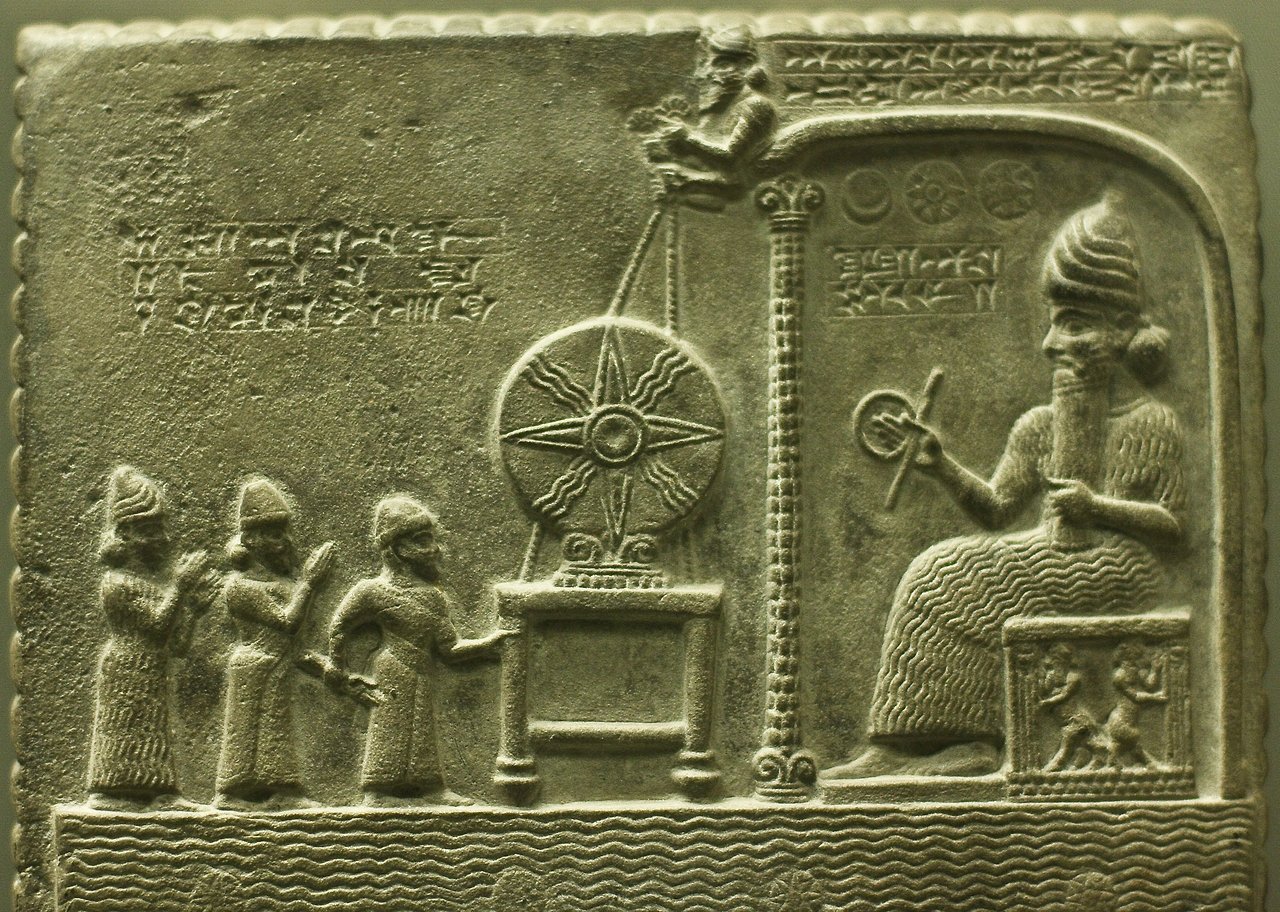
Ceremonies for “opening the mouth of a god” refer to “putting on the melammu,” the divine splendor, as if it were a sort of cloak. Kingship, too, is often described as something that “descended from Heaven,” and can be “carried” from one city to another. 
In light of all this, it seems very likely that – just as the term mé is untranslatable into our frame of reality – our discrete categories of “symbol,” “referent,” “abstract” and “concrete” would have been equally baffling to a Sumerian.  
This framing is so different from ours that it can be difficult to comprehend: a scepter does not symbolize kingship; it is kingship. The statue does not symbolize Enki; once its “mouth is opened,” the statue is Enki – even as the god Enki is not limited by this one statue, and dwells in the eternal ocean.
To ask whether the Sumerians thought of the mé as abstractions or physical objects is to pose a wrong question. The mé sat at the border between reality and Mind – and once the Sumerians had stumbled on that doorway, they took great pains to keep it open, and to facilitate passage across it. 
I knew none of this, of course, as I sat in my apartment paging through images of Mesopotamian archaeology. I only knew that I’d stumbled on some primordial wellspring of originality; a mystery I wanted not so much to solve as to experience for myself. 
.....
The great historian Thorkild Jacobsen describes the god Enki as “the numinous inner will-to-form in the Deep.” This is not the dead god of a vanished civilization – this is the Ocean where “2+2=4” and “the steam engine” and “scribeship” and “the troubled heart” have always lived, along with all things unimagined and yet to be.

To bring new things across the doorway, we must re-learn the trick of standing on its threshold.
Bravo Ben!

"The God Enki and the Ocean of Everywhen" is at:

https://thestrangecontinent.com/2017/08/03/the-god-enki-and-the-ocean-of-everywhen/


Sunday, 30 June 2019

VenusPeter's review of 'The Sacred History of Being'


A review of The Sacred History of Being at WorldCat:
The Sacred History of Being.
by Yaeger, Thomas
eBook : Document

Sometimes scholars do not see what is before their eyes, or they see what they are trained to see. The Sacred History of Being begins with an account of the author becoming aware - over many years - of the limitations of modern scholarship concerning the ancient past. There are so many unexamined assumptions in the relevant disciplines which make it nearly impossible to make sense of some of the evidence. The assumptions are a form of noise, which is hard to see through, and the understanding of most scholars is circumscribed by the din of that noise.

This is a book which discusses both the ancient past, and the modern post-Enlightenment world. The modern world comes off badly in comparison, since we now generally frame questions in terms which produce answers which make sense to us. What an ancient priest made of a question, for example, is often of no concern to us. We aren't dealing with rational thought in antiquity.

Yaeger's book is a sustained assault on this idea. It attempts to show that, long before the Greeks, the Mesopotamians explicitly understood themselves to be rational beings living in a rational universe. Their account of the creation of the world in which we live makes that very clear. That world is framed in their creation story as a descent into generated matter from an undifferentiated plenum. As a consequence, the Mesopotamians saw a connection between the plenum and knowledge far beyond human understanding. Yaeger argues that one of the functions of religion in Mesopotamia was to make connections possible between the transcendent world of the plenum (Being itself) and the secular world, and for man to gain access to knowledge of divine things.

Sound familiar? This is very similar to what Plato was discussing in the Republic in connection with the ascent of the philosopher to 'the Good' via the forms, and a return to the sensible world with beneficial knowledge. Yaeger does not rest on this simple comparison however, and digs deep into Mesopotamian ritual for the creation of divine images. The result of close study of these rare texts shows how thoroughly the parallels run between Greek and Mesopotamian thought. The Mesopotamian texts however date from a period before the rise of classical Greece...

The fifth century enlightenment in Greece therefore begins to look like a form of noise - a difficulty largely created during the European Enlightenment.

There are many good things about this book, not least of which is the quality of the writing and discussion. Once you have read the book, it is hard to look at the ancient world in the same way as we used to do. Much that looked like the result of a primitive stupidity (the practice of divination, sacrifice, etc), can now be approached in a different way, which presumes so much less about the nature of the ancient evidence.

Monday, 4 February 2019

Orientalism and the Post-Enlightenment Agenda (Writing to Katherine Blouin)


[In 2018 I had some brief conversation with Dr. Katherine Blouin via Twitter. Which prompted the following email]. 


 I thought I should tell you about my work, since I am part of the largely disorganised cohort working for a radical change in our understanding of the role of ancient Greece in the development of western civilization.

My initial background is in classics and philosophy. At UCL I also studied Mesopotamia (languages and culture). This study was across three departments - UCL ancient history (text corpus, with Amelie Kuhrt), UCL department of Hebrew (Sumerian, with Mark Geller), and SOAS for Akkadian language (mainly with Andrew George). As a result I left college with a view of the relationship between Greece and Mesopotamia which was quite different from what I was led to believe while I was there.

 I graduated in 1992. I've been writing on the relationship between Mesopotamia and Greece since then. I arrived late to Said's work, since I was initially in thrall to Martin Bernal's thesis in Black Athena (though I did attend Said's series of lectures at UCL in the fall of 1993).

My main interest is in the history of philosophy. The conventional history of philosophy is pretty much a fabrication, The evidence doesn't support what is said about it, and it isn't actually that difficult to detect the fraud. Which led me to consider why the fraud was easily accepted. The answer turned out to be, as Bernal suggested, the post-Enlightenment agenda. The Enlightenment sought to understand everything in terms of common sense explanations, and not much in ancient philosophy conformed to common sense ideas.

So I've been researching and writing, off and on since 1993, about the origins of philosophy, Greek philosophical writing, and the cultural history of the west.

I was also interested in the role of anthropology in our understanding of past modes of thought. In 1993 I wrote a study of Frazer's essay on Plato, in which he argued that the idea of 'Being' was a barren notion, and nothing useful could be said of it. That is not what they thought in antiquity. So his later work was essentially a reframing of the past with one of its most important concepts entirely written out (formally published in 2016).

Hence I wrote The Sacred History of Being, which was finally published in November 2015. The point of this book was to show two things (amongst others): that the concept of Being was of immense importance before Plato, and that modern arguments about the nature of the Divine did not at all resemble ancient arguments, and so we could not easily understand what the ancients were talking about.

So we have a real problem. I've published a couple of volumes since The Sacred History of Being, which largely serve to illuminate how the ancients understood both physical reality and the Divine. Without a grasp of their radically different way of understanding, much of the ancient world is just unintelligible (oracles, omens, sacrifice, extispicy, etc).

These extra volumes serve as the basis for understanding that most ancient divine cult was transcendentalist in nature. Meaning that religious thought already embraced ideas and abstractions which surface in the writings of Plato and others. In Mesopotamia, in Israel, in Egypt, in Phoenicia, etc.

Which brings me to where I am now. I showed in The Sacred History of Being that the Assyrians and Babylonians were capable of abstract thought, and conceived of the Divine as a pure abstraction. They understood the basis of dialectical thought (collection and division) which the Greeks are credited with. They embraced the idea of excellence as the Greeks did, and the concept informed the education of their kings. They understood morality to emerge from the logic of excellence, as the Greeks did. They also conducted public debates on the relative merits of this or that good thing, as the Greeks also did.

 I intend next year to publish a concluding volume in the series which provides the evidence for these Assyrian and Babylonian parallels.

 After that, the jig will be up for the classicists. But I have no expectation that they will take notice of what has happened.

 One of the [key] things they have taken on board from their subject is the pursuit of excellence. They pursue this through what they understand as the rigourousness of the study of their source materials. The context of these materials, and the rest of the world, have relatively no importance for them. So why should they change their views?

Thomas Yaeger, October 18, 2018. [Reply received]

Wednesday, 4 October 2017

Letter to a Student


[A response to an email from a student in New York which commented on matters discussed in an article I wrote for the Ritman Library Newsletter in December 2015, shortly after my first book was published. He has been studying the Italian renaissance, and is interested in the history of esoteric ideas, ancient and modern, and the connections between them. He is also interested in why college courses are set up in the way they are, so that they don't always address the kind of questions which a student might want to explore.] 


***


Many thanks for your mail, and for your comments on the article titled “The Esoteric Conception of Divinity in the Ancient World.” I was put on to the significance (and antiquity) of the Assyrian Sacred Tree by the Assyriologist Simo Parpola, who published an extensive paper on the subject in 1993 ('The Assyrian Tree of Life: Tracing the Origins of Jewish Monotheism and Greek Philosophy'). There is much discussion of the Sacred Tree in The Sacred History of Being.

By ‘esoteric texts … that cite Assyrian and Sumerian sources’, I assume you mean modern books on esotericism that mention these sources. You will be aware that you have to use these with circumspection, since some of them (not all of them) use their sources cavalierly, with no real grasp of the materials they are using, or the languages in which they are written.

But there are undoubtedly strong connections between esoteric writings from Mesopotamia, and the later esoteric traditions around the Mediterranean and in Europe. When I was in my early twenties I was reading about esotericism in the Italian and English renaissances. Afterwards I began to read texts from late antiquity, largely because these were referenced by the later writers. The continuity of thought was quite striking.

I worked my way back further. I found a text from the middle of the 14th century B.C.E. in a collection of ancient Egyptian literature which employed what appeared to be philosophical concepts, which, according to convention, were first aired in Classical Greece. That’s a difference of 900+ years
From that point on I was hooked.

You will know that Plato recounts in the Timaeus that his ancestor Solon visited Egypt. As did the historian Herodotus. In college both these claims were downplayed as unlikely, as if it was difficult to undertake travel to Egypt at the time. But we were also learning of the extensive commercial connections known between Greece and the eastern Mediterranean in the same period, involving the establishment of permanent trading posts with regular and substantial traffic to and fro. How hard would it have been to get a passage from Greece to Egypt on a cargo ship?

The downplaying of connections between Egypt and Greece, has been going on for a long time – at least since the beginning of the European Enlightenment. Most college professors are following a well-travelled track, which they assume to be a rational response to the evidence. As a consequence, they aren’t much interested in counter arguments, and evidence which suggests they are on a false track. They structure their courses accordingly. They aren’t being dishonest. They are just living and working in a discipline which employs a model of the past which (they think) has more plausibility than is the case.

I’ve discussed the origin of this problem at some length in my book. In the end, this question became almost as interesting to me as the study and interpretation of ancient texts. It turns out that human beings are (generally speaking) less curious creatures than we like to think, and that there are some things out there which they would rather avoid.

Others have radar for arguments which are on a different track, as you clearly have. So yes, I would be happy to correspond with you about various matters of interest. Subject to available time of course.

I concur with your decision to read my book once you graduate. I wrote in the preface that, though it is a scholarly work, it is not a text book, and that it would be less career-threatening to read it after credit courses are safely over.

Best regards,


Thomas Yaeger

Monday, 17 October 2016

'Shar Kishati' and The Cult of Eternity


This is part of a chapter from the draft of The Sacred History of Being which was under way in 2004. The chapter did not make it through to the final version which was published in November 2015, though I did write about the same things in the published version, in slightly different terms. I had moved on considerably in those eleven years.

Trying to separate out key aspects of Greek and Mesopotamian models of Reality, as I did here,  was something of a methodological conceit, and the discussion of the hypothetical core of the ancient understanding of Reality as something which might be separated from everything else,  doesn't mean that such a hypothetical core existed apart from the rest of the religious and theological implex of ideas which constituted Greek and Mesopotamian religion. The point of the exercise was to explore what was actually essential to that implex of ideas, and to get a better understanding of why it was important to the functioning of the ritual universe in both Greece and Mesopotamia.

So this text should be understood as a snapshot of how I was approaching the ancient data, and the different points of view I was exploring, as part of the study in 2004.

Essentially what I called in this text the 'Cult of Eternity' revolves around the 'Doctrine of Totalities', which is mentioned in connection with Pythagoras, is described by Plato, mentioned by the Neoplatonists, and is also referenced in a Nag Hammadi text. We know the doctrine was known in Babylon, and it is possible that Pythagoras learned of it while he was there. It is in fact a logical modality, though currently it is not recognised as such. It can be argued that this logical modality underpins the entire intellectual edifice of Mesopotamian thought, and much of the philosophical thought in ancient Greece, from Pythagoras onwards.

I have taken the liberty of re-Englishing some of the text, but the argument is as it was.

Thomas Yaeger, October 17, 2016

Defining the Cult


Why characterise the beliefs of some elite groups in Greece and
Mesopotamia as cultic, rather than considering them simply as elite groups
functioning within the social and institutional structures of these cultures?

The reason for this is quite simple: the belief system of these elite groups is at variance
with aspects of the more broadly based belief system of the culture in which the cult is
embedded. The cult in question enshrines a pattern of belief which is shared by a small
and influential group; it has great meaning for that group, and it informs
almost every aspect of their lives. It has all the characteristics of
individuated cults – liturgy, ritual, festival, sacred objects and images, etc. It
also has a secret at its core, which is often a feature of individuated cult*1.

It is not strictly a secret society however – or at least we have no reason to
believe that it functioned entirely in secret. This does not mean that it functioned in
public – rather that it functioned as an elite club, occasionally admitting new members,
according to merit. Thus, it would be possible for individuals outside the group to
know something of its existence, and perhaps to know individuals who belonged to the
group, as well as perhaps knowing the time and place of ritual, etc. But these individuals
would not know any significant detail of the cult, either in terms of practice or belief.*2
 It is a secret society however in terms of it having secret aims and beliefs, and a
restricted membership.

Its function was religious. The detail of what was involved and the belief
system which underpinned this activity is the focus of this study.
In essence what we have uncovered is a way of thinking of some
importance in history. It underpins the historical development of many
ancient religions, even if it is not itself older than these religions, or is not
native to the region in which the religions grew up.

It needs a name, if we are not always to be returning to the details of its nature
and influence in order to indicate its involvement. I have decided to call this
phenomenon the ‘Cult of Eternity’, since it is clear that emulation of the nature
of eternity is the principal goal of this school of thought: the source of the cult is
the understanding of the importance of invariance above all else, and the members
of the cult are focussed on eternity. Eternity is a concept which all important
religions - of which we have knowledge - have.

We are not talking here about an organisation with physical and intellectual
continuity across both time and the geography of the ancient world when
we talk about the ‘Cult of Eternity’: what we are talking about is a way of
thinking which might have been transmitted by contact between elite groups
over large geographical distances, but which, alternatively, might as easily
come to exist at a certain place and time whether or not such actual contact
has occurred. If it can arise as a notion spontaneously in the mind of one
man, then it has arrived within the culture in question.*3

If it subsequently informs the theological and religious structures of that culture,
then that form of cultic belief is of importance to the understanding of that culture,
and its dynamics.

It must be understood as a cult in the sense that it involves a shared set of beliefs,
understandings, and practices belonging to a small group within ancient cultures.*4
The true nature of these cultic beliefs were not understood – and perhaps not even
 suspected outside of members of the royal court, and some parts of the priesthood.

Notwithstanding the fact that we can often trace the ideas of the cult in the
art and literature and language of a culture, where elements associated with
the cult have shaped the outward form of the institutional religion, the
nature of the core ideas of the cult, then as now, make it very unlikely that
any but a small group of people with control of the political and religious
hegemony could hold these beliefs.

The Pattern of Belief


What is the essential nature of this cultic belief? It can be stated quite
simply, though its difficult passage through history has been as a
consequence of the fact that its essential nature it is so easy to miss, and to
lose, without any sense that something important has been lost.

It is lost when the understanding that the doctrine enshrines images which
are understood as recollections of the ur reality, turns into the notion that the
images themselves, whether in ritual or narrative or poetic form, represent
the matter of the cult, rather than pointers and paths to the real goal of the
cult.

In essence the central belief of the cult is that reality itself is utterly
transcendent of all the characteristics and properties of earthly existence.
The divine, as a consequence of this understanding, is understood as
entirely beyond our human ability to grasp, except in terms of a crude
inversion of the categories normally employed in our understanding. This
idea of reality is conveyed and referred to by means of a number of images
– these may be actual images, through descriptions of images, through
ritual, through narrative, and through mythic and poetic constructs.

One of the key concepts of this cult is the distinction between the secular
and the eternal. Most of the desirable (and as Robert Graves might say,
‘nostalgic’) characteristics of reality are imaged in the idea of the eternal. It
does not move, does not participate, but simply is itself. The moving image
of eternity, which we have seen is of central importance in the Greek
version of the doctrine of the cult, is the one which does participate in
generation, which does move. Significantly, it is itself described as an
image, since it, along with all the elements of secularity within the moving
image, is an approximation, a metaphor to the all but indescribable and
unreachable.

The second aspect of this pattern of belief in a completely transcendent ur
reality, is that there are certain areas of earthly reality which are closely
connected with the ur reality. These areas are the limits or boundaries of
things. A characteristic of a limit or a boundary is that it is the place where
something passes into something else. In this place, the utter limit of
something is no longer what it is, but is the place between what that thing
was (whatever it was) and the thing which is beyond. In other words, the
boundary or limit is a no-man’s-land in terms of categorical understanding.
In consequence, it resembles very strongly the nature of the divine.

Why this Pattern?


Why do these properties of both the ur reality and of boundaries and limits
have such importance for those involved in the cult? Because the ur reality
is the place of generation, the place of the ur decisions – the principal
separations and divisions of eternity, the place of ultimate completion – the
ur of all and everything. Like the soil of the original home of a tribe, packed
into its ritual altar, its ‘first earth’, eternity is the place and condition of
resort when change, joining, sundering, enhancement, and judgement are
required. The devotee of the cult can, by means of its rituals and discipline,
both travel there, and bring eternity to the here and now.

The tribe need not have a theory of being to know the importance of ‘first earth’,
and it is not necessary for there to be a theory of being behind the existence and
importance of the practice. However it is clear that the concept of an ur
reality has abstracted to the nth degree many of the simpler notions which
occur to man, and brought them together, as Solon suggested to Croesus, ‘to
arrive at the proper time and agree’.*5 Where we find many clues to the
existence of this abstracted and rarified vision of the other in one or several
cultures, we cannot ignore these clues without damaging our capacity to
understand the cultural processes at work.

One of the problems which historians face in studying the ancient world is
the problem of studying patterns of belief which, are full of the practice of things
which have become reprehensible or meaningless - magic, witchcraft, divination
and sacrifice. To the modern scholar, these are credulous beliefs, without
foundation in anything which makes sense to the rational mind, and so the
historian is expected to have no sympathy wth the patterns of thought involved -
beyond that necessary to explore the social and cultural dynamics of these beliefs
in the material under examination. It is of course perfectly possible to write an excellent
study of a belief system without the writer sharing that belief system, but, for the
sake of professional credibility, it is important that objectivity – the ‘not sharing’ in
the belief system under study – is visible and public. Hence there is a tendency for
historians to avoid as far as possible discussion of beliefs and the intellectual undertow
of ancient practice, and where they find it necessary to engage with it, they usually
describe rather than analyse.

The difficulty of a historian is therefore very great, if we attempt to bring in
from the cold the common practice of the ancient world, and its intellectual
origins within a pattern of cultic belief and ritual. If it is more like what we understand
 than we (formerly) understood, and belongs to the known tradition of understanding
the world in terms of the relationship between being and the world of becoming,
then a danger emerges that the work involved might seem like a rehabilitation rather
than an objective study.*6

Who would be safe? The objectivity of a discipline can mean that the object of
study is preferred lying dead on the dissecting table, rather than as something whose
whole nature requires study as a living thing: the object is studied as an ‘it’ rather than as
 a ‘thou’. Where its dynamics are explored, these are often framed within modern
models of the forces at work in social structures, since these are the product of rational
discussion over many decades, and give us the tools and approaches to understand social
dynamics.

But is this really adequate as an approach? The cultures of the ancient world once lived,
and it is important to look at them as living things, driven by by their own will and
concerns. Looking at these cultures as supported and vivified by the powerhouse of a
theory of Being allows us to understand what it is that shapes them, and to understand
the connections between that powerhouse and more distributed and diffuse practices and
phenomena.*7

The cult itself is sustained by the inner logic of its belief system. Based on the
understanding of the importance of the concept of the eternal, it shares
serveral features with the religion in which it functions as the intellectual
core, supplying access to the functional aspects of the ur reality. Serving in
this way, it has a technical language, and technical logic. Much of this, particularly in
the fine detail, is lost to us within Mesopotamian culture, and we must also use non-textual
evidence as part of the recovery technique. But sometimes it peeps out at us, utterly
 inexplicable within the now traditional modes of interpretation which are applied to
near eastern  civilisations.

One example of this is the Akkadian phrase ‘Shar Kishati’, which was applied to Assyrian
Kings in the 1st Millennium B.C.E. The phrase literally means: ‘King of
Totality’. This makes very poor sense outside of the context of a cultic model
for the importance of the king – the phrase does not specify the nature or context of
the totality – whether it is to be understood as a totality of nations, of peoples, or even of
the world.

Within the context of a cult which has the pursuit of eternity at its core, the epithet
makes perfect sense: totality is one of the ways in which eternity may be
spoken of, since the eternal is the undivided and undifferentiated ur reality,
before the creation, the moving image of the same. The phrase ‘King of the
Four Quarters’ similarly does not refer (except where made explicit) to
earthly power and hegemony. The ‘four quarters’ refer to a division of the
ur reality or totality made by the cult, in which the properties of kingship
are defined in terms of different images of his transcendence over the
world.

These images are connected with the bull, the ram, the eagle, and
man. Other combinations of images are possible, and  found, but these
four are the principle ones. Very often aspects of these animals are brought
together in images of the King and of the sages, so that the leg of the king is
overmuscled to invoke the strength of the bull; his cloak is feathered in
order to invoke the power and clarity of vision of the eagle*8, and he wears
a torque around his arm whose ends are marked with ram’s heads, a
favoured animal for the purposes of enquiry by divination. The human part
of the quartet represents intelligence and the rational part of the soul.

That this totality of the four quarters is something to which limits and
borders are closely associated is clear from the fact that the quartet of
images is often combined in the sacred winged bulls, found situated within
the limits of palaces and temples, marking the gateway between the
precincts of the palace or temple, and the outside secular world of movement
 and change.

Notes -


1 We are familiar with the existence and importance of the indivuated Greek cults,
which eventually assumed an enormous importance in the later Roman Empire.
Herodotus sometimes mentions these cults, but makes offhand references to the
nature of the rites performed in thse ceromonies, saying ‘those who have experienced
 them will know what I mean’. The details were secret from the uninitiated. We do not know
about the details of the cult of the Great Gods, the Kabiroi at Samothrace, on account of
this reticence on the part of Herodotus. As for Mesopotamian cults, we know that the whole
religious edifice functioned more or less as an assemblage of individuated cults. Those in
the lower levels ofsociety were simply not admitted to cult buildings at all, far less being
admitted to worship or to participate in ritual. So far however, it has not been considered as a possibility that the whole thing was held together by a cult which might be restricted to an
even smaller group, initiated into a cult whose ideas reflect a different kind of
intellectual picture of the world

2 Of course there are exceptions to this rule. The journalist Richard Carlile gained access to
Masonic ceremonies and documents in the early years of the 19th century, and wrote
extensively about this cult. Though he was pilloried for his efforts at the time, it was not
long before his ‘Manual of Masonry’ was being used in preference to official texts by the
members of the craft – indeed, one of the two copies I own has clearly been marked by
someone learning the rites of the craft.

3 The question of the routes by which the ideas of the cult have moved around is
nevertheless interesting, and in some instances it is possible to point at likely nodes
of contact and exchange. However this question is beyond the scope of this book.

4 I have defined the belief in the importance and efficacy of eternity as a cult for two
principal reasons. The first is that this belief is clearly necessarily confined to a small
group or network of individuals, for the simple reason that the nature of some of the
beliefs belonging to the cult would be anathema to the wider population. Talking of a
divine nature which has none of the properties of earthly existence could easily be
misunderstood as atheism. The second reason for defining this pattern of belief as cultic is
that, during the first millennium B.C. E., the belief system was more often than not
accompanied by cult ritual.

5 Those who invite for example the pre-eminent anthropologist of the ancient
world, Walter Burkhert, as keynote speaker to a conference on the subject, are perhaps
 unconsciously exhibiting similar behaviour to tribal elders who place ‘first earth’ at the
core of their cultic life.

6 We are familiar with the Platonic tradition, which, through a number of twists and
turns, is more or less continuous as a body of ideas in the west during the past two
and a quarter millennia. It isn’t a tradition which is continuously active, in that it is not always worked within, and sometimes it has lain fallow. However we can trace a continuous tradition
based on the original Platonic corpus all the way from classical Greece to modern times.
And sometimes this tradition has actively shaped institutions and patterns of belief.

Examples of the powerful influence of this tradition include the neo-Platonist writings, the
take-up of Platonic ideas within the court and intellectual life of the Italian Renaissance,
and its particularly fertile influence in the English Renaissance of the late sixteenth
century. What is being suggested here is that a similar pattern of tradition existed in the
ancient world before Plato, and that the Platonic writings, rather than instituting something
entirely new, refashion an existing tradition of arcane cultic ideas, passed on largely
through oral means, within small and select groups within institutions which offer a
conducive and receptive environment for these ideas. Plato therefore is one highly important
node in the tradition, particularly because he is deliberately trying to pass on a body of ideas being threatened by a wholly secular view of the world.

7 If it is faulty to approach ancient societies which are replete with magical practice as
supported by a theory of being which informs much of the detail of its belief and practice,
then we will find out our error soon enough: we will find no evidence to support the claim
which is not inexplicable by other means. Some of the key pieces of evidence in this book
have no explanation in terms of existing interpretative schema: they are not treated as
evidentially significant, even when they clearly absorbed much of the ancient economy, as
well as the time and intellectual focus of the elite of the society in question.

8 Most probably the feathered cloak also is intended to conjure the idea of the king
functioning in another world, as the eagle can exist on land, but has its true existence
 in the air